
Pre-Pour and Pre-Closure Checks: Using Visual AI to Cut Construction Rework
How visual AI and agentic QA/QC hold points verify rebar, formwork and MEP work before it is concealed, cutting rework and building an evidence trail for every inspection.
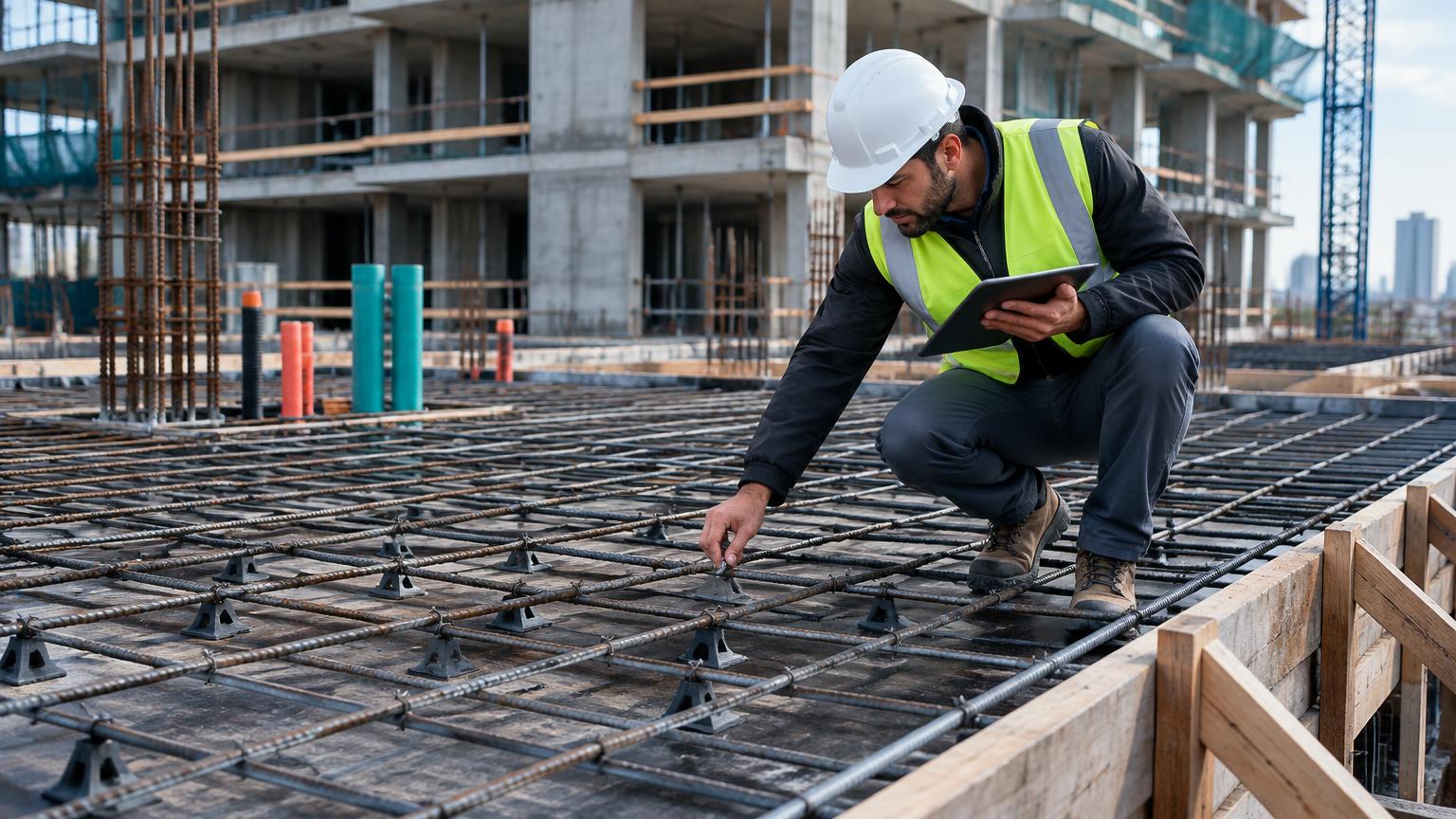
Most expensive rework happens because work is concealed before anyone verifies it: a slab poured over misplaced rebar, or a ceiling closed over incomplete services. Visual AI reduces this by capturing timestamped evidence at each hold point and comparing it with the drawings and BIM model. Agentic QA/QC goes one step further: it holds the sign-off until the evidence is complete, then raises a non-conformance report (NCR) automatically if something is wrong.
Why rework happens
Rework rarely comes from one big mistake. It comes from small gaps in the inspection chain: a hold point skipped because the pour was booked, a checklist ticked from memory, or a photo taken but never reviewed. Once concrete is poured or a ceiling is closed, fixing the error means demolition, delay and a dispute over who pays.
The critical hold points, trade by trade
Reinforcement
Before pour
- What to verify
- Bar size, spacing, cover, laps, chairs
- Cost if missed
- Very high: breaking out concrete
Formwork
Before pour
- What to verify
- Alignment, levels, props, openings and sleeves
- Cost if missed
- High: structural defects, rework
MEP rough-in
Before ceiling or wall closure
- What to verify
- Routes match model, supports, sleeves, test tags
- Cost if missed
- High: opening finished surfaces
Firestopping
Before closure
- What to verify
- Every penetration sealed
- Cost if missed
- High: fails fire inspection
Waterproofing
Before screed or tiling
- What to verify
- Membrane continuity, upturns, laps
- Cost if missed
- Very high: leaks found after handover
Blockwork and plaster
Before finishes
- What to verify
- Line, level, embedded services
- Cost if missed
- Medium
How visual AI supports QA/QC
01Capture at the hold point
The site engineer captures the area with a 360° camera or phone before concealment. Each image is tied to its location on the drawings.
02Compare with design
Where a BIM model exists, installed elements are compared with the model to flag missing or misplaced items.
03Link to the ITP
Evidence is attached to the relevant line of the inspection and test plan (ITP), so the record shows what was checked, by whom and when.
04Track nonconformances
Any issue becomes an NCR with photo evidence, an owner and a target date.
05Keep the visual record
Concealed work remains viewable later, which helps with maintenance, variations and disputes.
Ask, Watch, Act: agentic QA/QC
Ask
QA/QC managers and project managers query quality status directly.
- “Is Level 5 slab cleared for pour?”
- “List open NCRs older than 7 days, by trade.”
- “Show me the MEP above the ceiling in Room 304 before it was closed.”
Watch
Agents enforce the inspection chain.
- A hold-point agent blocks pour or closure sign-off until the ITP evidence, including photos and the completed checklist, is in place.
- A repeat-defect agent flags the same issue recurring with one subcontractor or in one zone.
- A deviation agent compares captured MEP routes with the BIM model before closure.
Act
Agents handle the follow-up.
- Raise an NCR with photo evidence, assign the responsible subcontractor, and set a target date.
- Notify the QA/QC manager and the project management consultant (PMC) when a hold point is ready for sign-off.
- Compile the weekly quality report: open NCRs, closure times and repeat defects.
Sign-off always stays with the QA/QC engineer or consultant. The agent makes sure nothing reaches them incomplete.
Missing evidence or a deviation stops the sign-off, not the site: the owner fixes it, uploads new evidence, and the check runs again.
The cost of rework
Rework costs include more than labor and materials: delay to following trades, extended site overheads, and the cost of resolving disputes.
Results to expect
Track these outcomes against your project’s baseline:
- Defects found before concealment versus after: how many issues are caught while the work is still accessible.
- NCR average closure time: the time taken to resolve and verify each nonconformance.
- Rework cost avoided per project: avoided labor, materials, delays and related costs supported by project records.
FAQ
Can AI check rebar spacing from images?
Visual AI can flag visible issues such as missing bars, inconsistent spacing or missing sleeves. Critical structural checks still need sign-off by a qualified engineer. Confirm the available SiteSense checks for your project before relying on them.
What is an inspection and test plan (ITP)?
An ITP lists every inspection and test required for a scope of work, including hold points where work cannot continue until approval.
What is a hold point in construction?
A hold point is a stage where work must stop until a nominated person inspects and approves it, such as before a concrete pour.
Do we need a BIM model?
No. Hold-point evidence and NCR tracking work from drawings. BIM adds automatic deviation checks.
Explore SiteSense for construction →
Read about BIM-based progress tracking →
Read the practical guide to AI agents for construction project management →